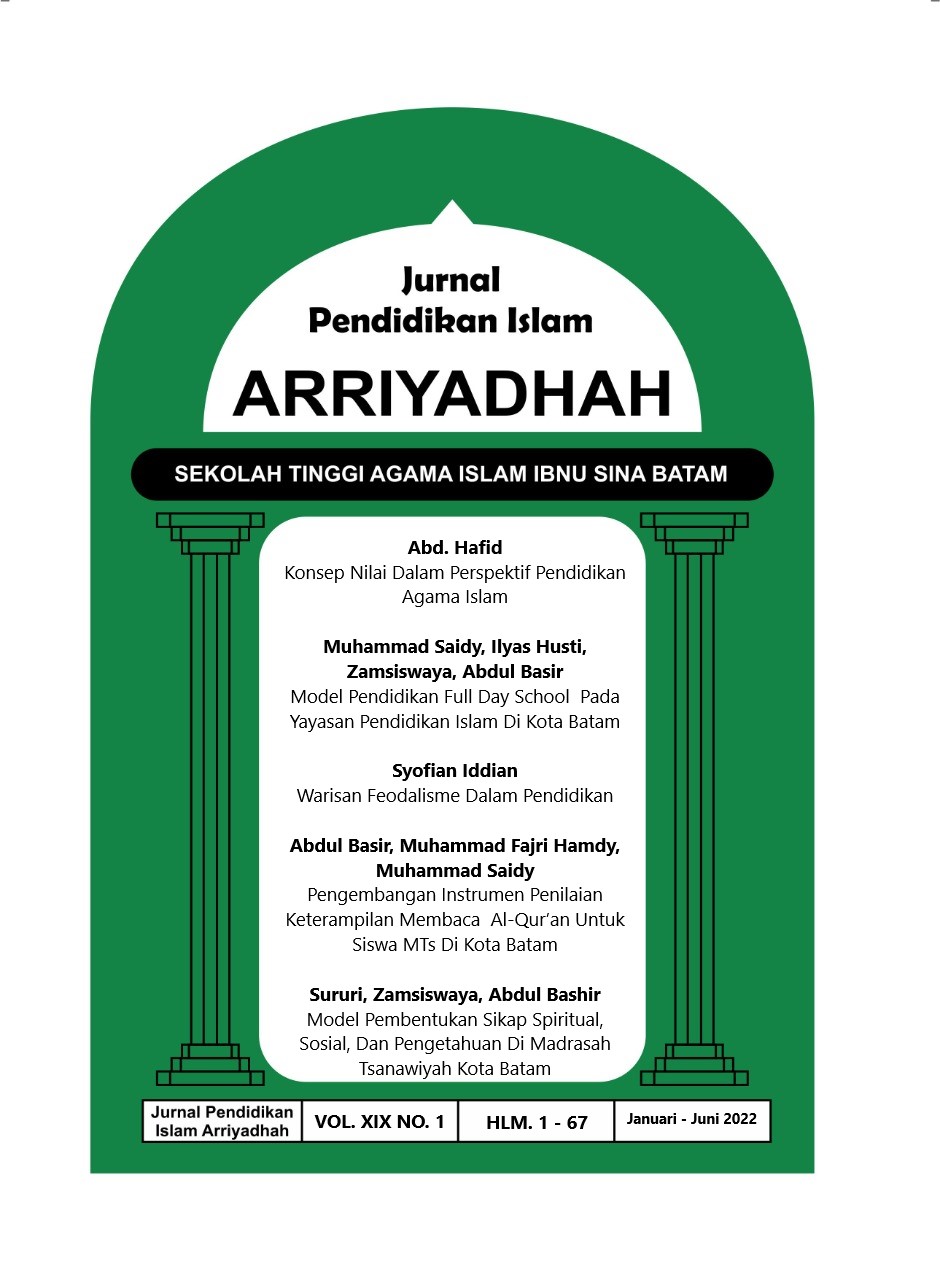
Konsep Nilai Dalam Perspektif Pendidikan Agama Islam
Keywords:
Values, Concept of Islamic Values, Islamic Religious EducationAbstract
This journal article aims to describe the concept of value in the perspective of Islamic education. Islamic education is a process of direction and guidance to realize complete human beings, mind and heart, spiritual and physical, morals and skills so that they are ready to live a good life anywhere and anytime based on Islamic values. system so that the value has a very high position. The method used is library research method by using a method to obtain information data by placing existing facilities in the library, such as books, magazines, documents, historical stories records and so on. The results of the study show that the sources of values that apply in the institutions of human life are classified into two, namely Divine Values and Human Values. Divine value is a value that is innate by God through His Apostles in the form of faith, piety, justice enshrined in divine revelation. While human values are values that grow on the basis of human agreement and live and develop from human civilization, these values are dynamic. There is a strong relationship between divine values and human values. It's just that the divine value (religious ethical life) has a higher vertical position than other life values. In addition, divine values have a higher hierarchy because religious values have consequences on other values. On the other hand, other values require a foothold in the form of religious ethical values.
References
Abdulsyani. (2007). Sosiologi Skematika, Teori, dan Terapan. PT Bumi Aksara.
Agama, D. (1971). Al Qur’an dan terjemahnya. Yayasan Badan Penterjemah Al Qur’an.
Agus, B. (2007). Agama Dalam Kehidupan Manusia. Rajawali Press.
al-Syaibany, O. M. A.-T. (1979). Falsafah Pendidikan Islam. Bulan Bintang.
Al-Banna, H. (2002). Majmu`at Rasa’il Al-Imam Al-shahid Hasan Al-Banna. Dar al-Da’wah.
Al-ghazali, I. (2014). Mutiara Ihya Ulumuddin. PT Mizan Pustaka.
Alisjahbana, S. T. (1974). Values as Integrating Forces in Personality, Society and Culture.
University of Malaya Press.
Al-Jamaly, M. F. (1986). Filsafat Pendidikan Dalam Al-Quran.
Al-Jazairi, S. A. B. J. (2015). Minhajul Muslim. Pustaka AL-Kautsar.
Allport, G. W. (1945). Personality: A Psychological Interpretation. Henry Holt.
Ashraf, S. A. (1989). Horison Baru Pendidikan Islam (Terj Sori Siregar). Pustaka Firdaus.
Azra, A. (1999). Pendidikan Islam: Tradisi dan Modernisasi Menuju Milenium Baru. Logos
Wacana Ilmu.
Azra, A. (2012). Pendidikan Islam: Tradisi dan Modernisasi di Tengah Tantangan Milenium III.
Kencana kerja sama dengan UIN Jakarta Press.
Banks, J. A., & Rokeach, M. (1985). Teaching Strategies For the Social Studies: Inquiry, Valuing,
and Decision-Making. Addison-Wesley Pub. Co.
Banks, J. A., & Rokeach, M. (1990). Teaching Strategies for the Social Studies. Longman.
Berry, J. W. (1997). Imigration, Acculturation, and Adaption. Journal Applied Psychology: An
International Review, Vol. 46(I).
Daradjat, Z. (2008). Ilmu Pendidikan Islam. Bumi Aksara.
Departemen Agama RI, D. A. R. (2009). Al Qur’an dan Terjemahnya. Bumi Aksara.
dkk, I. S. (2001). Paradigma Pendidikan Islam. Pustaka Pelajar.
Encyclopedia Britanica (Vol. 28). (n.d.). Lexington Avenue.
Eyre, R., & Eyre, L. (2010). Teaching Your Children Values. Simon and Schuster.
Faisal, A. (1995). Reorientasi Pendidikan Islam (cet. 1). Cerna Insani.
Geertz, C. (2014). Agama Jawa-Abangan-Santri-Priyayi dalam Kebudayaan Jawa (Cet. II).
Komunitas Bambu.
Geertz, C. (2016). Tafsir Kebudayaan (Cet. IV). Penerbit Kanisius.
Gillin, J. L., & Gillin, J. P. (1954). Cultural Sociology. The Macmillan Company.
Hadiwijono, H. (2000). Religi Suku Murba di Indonesia. BPK Gunung Mulia.
Halstead, J. M. (2007). Islamic Values: A Distinctive Framework for Moral Education. Journal of
Moral Education, 36(3), 283–296.
Hill, C. P. (1960). Sugesstion on the Teaching of History. Blackwell.
Ilyas, H. Y. (2011). Kuliah Aqidah Islam. Lembaga Pengkajian dan Pengamalan Islam.
JR. Adisusilo, S. (2014). Pembelajaran Nilai Karakter. PT. Raja Grafindo Persada.
Karsidi, R. (1998). Masyarakat Komplek Perumahan Industri dan Penduduk Asli di Desa
Sekitarnya. Pustaka Graffiti.
Kaswardi, E. K. (1993). Pendidikan Nilai Memasuki Tahun 2000.
Kluckhohn, C., & Kelly, W. H. (1944). The Concept of Culture.
Kuntowijoyo. (1991). Paradigma Islam: Interpretasi untuk Aksi. Mirzan.
Kuntowijoyo. (2001). Muslim Tanpa Mesjid. Mizan.
Langgulung, H. (1980). Beberapa Pemikiran Tentang Pendidikan Islam. Alma’arif.
Langgulung, H. (1992). Asas-Asas Pendidikan Islam (cet. II). Pustaka Al-Husna.
Lubis, M. (2008). Evaluasi Pendidikan Nilai: Perkembangan Moral Keagamaan Mahasiswa
PTAIN. Pustaka Pelajar.
Muhaimin, & Mujib, A. (1993). Pemikiran Pendidikan Islam. Trigenda Karya.
Ogburn, W. F., & Nimkoff, M. F. (1950). Sociology. Houghton Mifflin.
Pals, D. L. (1996). Seven Theories of Religion. Oxford University Press.
Parekh, B. (2008). Rethinking Multiculturalism: Keberagaman Budaya Dan Teori Politik. Penerbit
Kansiius.
Parsons, T. (1991). The Social System 2nd Edition. Routledge.
Qardhawi, Y. al. (1980). Pendidikan Islam Dan Madrasah Hasan Al-Banna. Bulan Bintang.
Qutb, M. (1984). Sistem Pendidikan Islam (cet. I). PT. Al-Ma’arif.
Rahman Getteng, A. (1997). Pendidikan Islam dalam Pengembangan Moral, Remaja, Wanita, dan
Pembangunan. Yayasan Al-Ahkam.
Rakhmat, J. (2013). Psikologi Agama: Sebuah Pengantar. Mizan Pustaka.
Redfield et.al, R. (1936). Memorandum of the Study of Acculturation. American Anthropologist.
Ricklefs, M. C. (2008). Mystic Synthesis in Java: A History of Islamization from the Fourteenth
to the Early Nineteenth Centuries. Journal of the Humanities & Social Sciences of
Southeast, 164(2/3).
Ritzer, G. (2009). Teori Sosiologi; dari Teori Sosiologi Klasik Sampai Perkembangan Mutakhir
Teori Sosial Moderen. Penerbit CV. Rajawali.
Shihab, M. Q. (2011). Tafsir al-Mishbah: Pesan, Kesan, dan Keserasian al-Qur’an (Vol. 10).
Lentera Hati.
Suryawati, M., &. (2003). Sosiologi 1. Erlangga.
Syam, N. (2005). Islam Pesisir. LKiS.
Syari’ati, A. (1979). On the Sociology of Islam. Mizan Press.
Taneko, S. B. (1984). Struktur dan Proses Sosial, Suatu pengantar Sosiologi Pembangunan.
Rajawali.
Taym?yah, A. ibn ?Abd al-?al?m I., & Tirmidh?, M. ibn ??sá. (2006). Syarah Aqidah Wasithiyah:
Syeikhul Islam Ibnu Taimiyah. Perniagaan Jahabersa.
Tilaar, H. A. R. (2004). Paradigma Baru Pendidikan Nasional (cet. II). Rineka Cipta.
Titus, H. H., Smith, M. S., & Nolan, R. T. (1995). Living Issues in Philosophy. Van Nostrand
Company.
Weber, M. (n.d.). Sosiologi Agama. IRCiSoD.
Woodward. (n.d.). Islam Jawa: Kesalehan Normatif versus Kebatinan.
Young, K., Mack, W., & Raymond. (1959). Sosiology and Social Life. American Book Company.
Yusef, W., & Davids, N. (2014). Islamic Education, Possibilities, Opportunities and Tensions:
Introduction to the special Issue. Studies in Philoshopy and Education, Vol.
(No.3.227.231)